 Botanical name: Plantago lanceolata
Family: Plantaginaceae
General information
Ribwort plantain is a very common weed, with its distinctive long, narrow leaves and clusters of erect plantain like flower heads.
The flower heads (refer to a ‘soldiers by children’) have been used to play games by generations of children.
Ribwort plantain has various medicinal uses. The leaves are used in herbal teas as a remedy for coughs, hay fever and asthma, they can also be used to make a soothing cream to treat sores and insect bites.
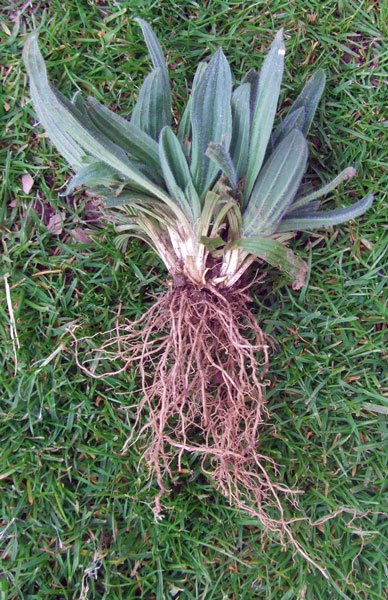
This plant is a rosette forming perennial with a fibrous root system. When it is left undisturbed in roadside verges or grassy areas it can grow nearly 50 cm tall. In mown turf it will grow as a flat rosette that adapts to the height to which the grass is being cut, making it a troublesome turf and lawn weed.
This weed reproduces via seed and has a shallow fibrous root system. Plantains are often found on compacted soils and can be an indication that some form of remedial action, such as aeration, needs to be taken to correct the problem. Ribwort plantains thrive in alkaline conditions and can tolerate very dry soils.
Ribwort Plantain Identification
- Leaves: The dark green leaves, which are rosette at the base, are long and narrow (lanceolate), typically between 10 – 30cm long. Each leaf, which tapers into a pointed tip has a smooth surface and between 3 -5 parallel prominent veins. The leaves are somewhat narrower than those of greater plantain.
- Flowers: The flowers are borne on several long grooved stalks, with the flower heads measuring between 10 – 20mm in length. Each flower head bears greenish – white flowers, which turn into seed pods producing between 10 – 20 each.
- Roots: Ribwort plantain has fibrous roots.
Ribwort Plantain Images (click image to enlarge)
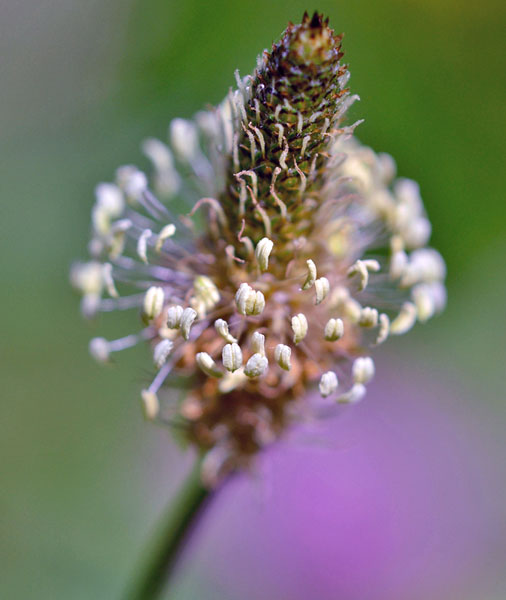
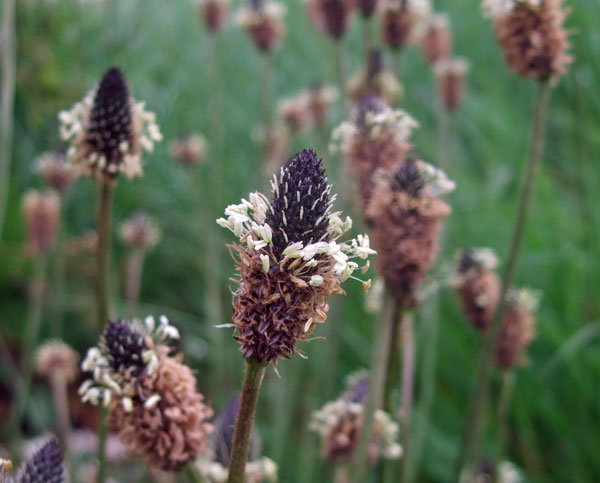

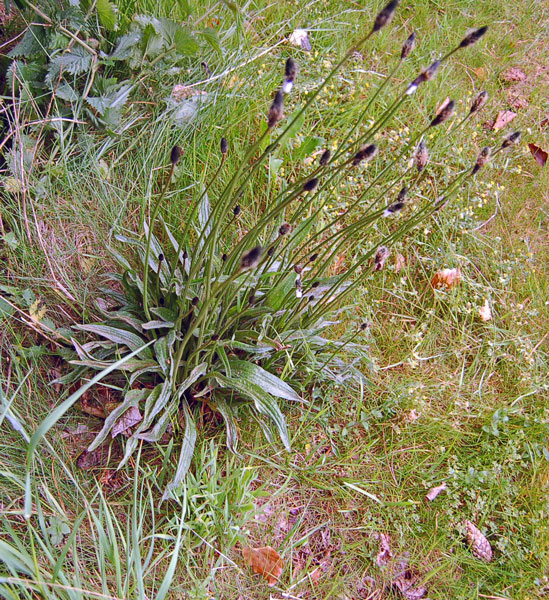
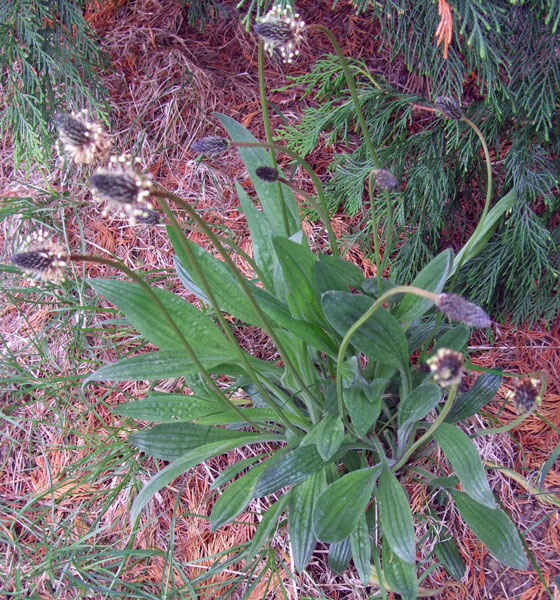
More images and free downloads of ribwort plantain
Prevention and control
Using a small knife or grubber this weed can be removed by hand, taking care to remove the whole of the plant from the soil.
Close regular mowing prevent the weed from reproducing by removing the seeds heads before they have chance to form.
Maintain good turf vigour with a balanced feed program to help prevent weeds from invading.
Aerate on a regular basis to help relieve soil compaction.
Irrigate during dry periods to help the grass maintain good vigour and sward density.
Ribwort plantain can be controlled using a selective herbicide. Remember to always try and keep chemical use to a minimum and treat the weed only when necessary. In many cases this weed can be spot treated, especially if the infestation is in the early stages and the plants are few in number.
It is any easy weed to control with a selective herbicide and most products available will take care of it with a single treatment, rarely is is a follow up treatment needed.
Recommended products for the control of ribwort plantain.
Professional products (The user requires the appropriate certificate/s to apply these products)
Headland Relay Turf (Mecoprop-p, Dicamba, MCPA)
Headland Cabadex (Fluroxypyr, Flurosulam)
React Ultra (Mecoprop-p, Dicamba, MCPA)
Everris Praxys (Clopyralid, Fluroxypyr, Fluosulam)
Bayer Longbow (Mecoprop-p, Dicamba, MCPA)
Barclay Holster XL (2,4-D, Fluroxypyr, Dicamba)
Mascot Greenor (Clopyralid, Fluroxypyr, MCPA)
Mascot Junction (2,4-D, Flurosulam)
Mascot Crossbar (2,4-D, Flurosulam, Dicamba)
Vitax Esteem (2,4-D, Clopyralid, MCPA)
Products available for non-professional use (These products are available from garden centres and DIY stores)
Verdone extra (Clopyralid, Fluroxypyr, MCPA)
Resolva lawn weed killer (2,4-D, Mecoprop-p, MCPA, Dicamba)
Doff lawn spot weeder (2,4-D, Mecoprop-p, Dichlorprop-p)
Vitax Lawn Clear (2,4-D, Clopyralid, MCPA)
Vitax Green up weed & feed (Dicamba, MCPA)
Weedol lawn weed killer (Clopyralid, Fluroxypyr, MCPA)
Scotts lawn builder weed & feed (2,4-D, Dicamba)