Botanical name: Hypochaeris radicata
Family: Asteraceae
 General information
Cats ear is one of the most common of the dandelion like weeds. This perennial plant is common on roadside verges and other grassy areas. It can also be quite troublesome in all managed turf, such as sports fields golf tees and fairways.
It forms as a flat basal rosette which can adapt to most mowing regimes enabling it to survive under the cutting height of the mower. However, it can reach heights of between 20 – 60mm (sometimes taller) if it is left undisturbed. It is the ideal plant for introducing into a wild flower mixture, however it is an undesirable plant in turf and lawns.
Cats ear can withstand a low cutting height and will happily thrive in light, free draining rootzones
Like dandelion, it anchors itself into the soil with a deep, stout tap root which helps it thrive in drought stricken turf. In fact is quite common on free draining sites. Reproduction is by seed and cats ear can produce mature flowering plants within a couple of months.
Cats ear Identification
- Leaf: The oblong or lance leaves can grow up to 20cm in length forming from a basal rosette. Each leaf blade is irregularly lobed (the lobes resembling a cats ear) and often covered in fine silvery / white hairs on both the top and underneath. This differs from the dandelion which has smooth leaves and is much more heavily toothed.
- Flowers: The bright yellow flowers are borne on branched stalks and measure 25 – 40mm in diameter. The flower stalks can reach 60cm high and have leaf like bracts, if broken or snapped the stalks contain a milky sap. The flowering period is between June and September.
- Root: The tap root penetrates deep into the ground, enabling the weed to withstand dry conditions
Cats Ear Images (click image to enlarge)
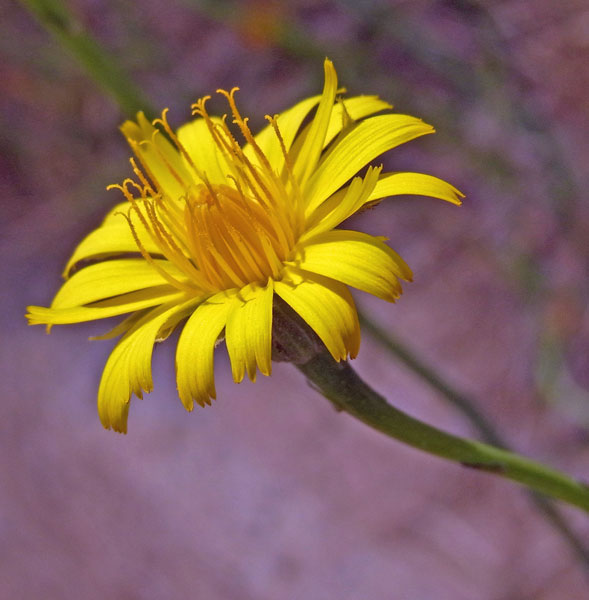

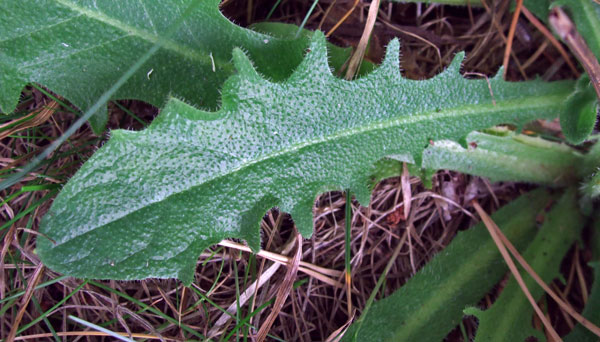


More images and free downloads of Cats Ear
Prevention and control of cats ear
Prevent cats ear from spreading with regular mowing to prevent the seed heads from forming. Ensure good turf health with a balanced feed program and irrigate during times of drought to maintain good grass cover and reduce stress.
This weed can be removed by hand with a suitable tool such as a daisy grubber or small garden fork. For the most effective result remove them when the ground is moist, so as to remove the whole of the tap root. If any of the root is left in the ground then this plant will regenerate.
As cats ear forms solitary plants a spot weeder is ideal for treating this weed. Spot weeders are available from most garden centres and DIY stores and come pre-mixed (no mixing is required) and is simply sprayed onto the weed.
A heavy infestation of cats ear may require a blanket treatment with a herbicide. If practical just treat the area/s of lawn or turf where the weed is growing, this helps keep chemical use down to a minimum.
Cats ear can be a a little stubborn to chemical use and two applications may necessary for satisfactory control. The second application should be applied around 6 weeks after the initial treatment. N.B. The herbicides available for professionals will be more effective than those for amateur use and in most cases a single application should suffice.
Selective herbicides available for the control of cats ear
Professional products (The user requires the appropriate certificate/s to apply these products)
Headland Relay Turf (Mecoprop-p, Dicamba, MCPA)
Headland Cabadex (Fluroxypyr, Flurosulam)
React Ultra (Mecoprop-p, Dicamba, MCPA)
Everris Praxys (Clopyralid, Fluroxypyr, Fluosulam)
Bayer Longbow (Mecoprop-p, Dicamba, MCPA)
Barclay Holster XL (2,4-D, Fluroxypyr, Dicamba)
Mascot Greenor (Clopyralid, Fluroxypyr, MCPA)
Mascot Junction (2,4-D, Flurosulam)
Mascot Crossbar (2,4-D, Flurosulam, Dicamba)
Vitax Esteem (2,4-D, Clopyralid, MCPA)
Products available for non-professional use (These products are available from garden centres and DIY stores).
Verdone extra (Clopyralid, Fluroxypyr, MCPA)
Resolva lawn weed killer (2,4-D, Mecoprop-p, MCPA, Dicamba)
Doff lawn spot weeder (2,4-D, Mecoprop-p, Dichlorprop-p)
Vitax Lawn Clear (2,4-D, Clopyralid, MCPA)
Vitax Green up weed & feed (Dicamba, MCPA)
Weedol lawn weed killer (Clopyralid, Fluroxypyr, MCPA)
Scotts lawn builder weed & feed (2,4-D, Dicamba)